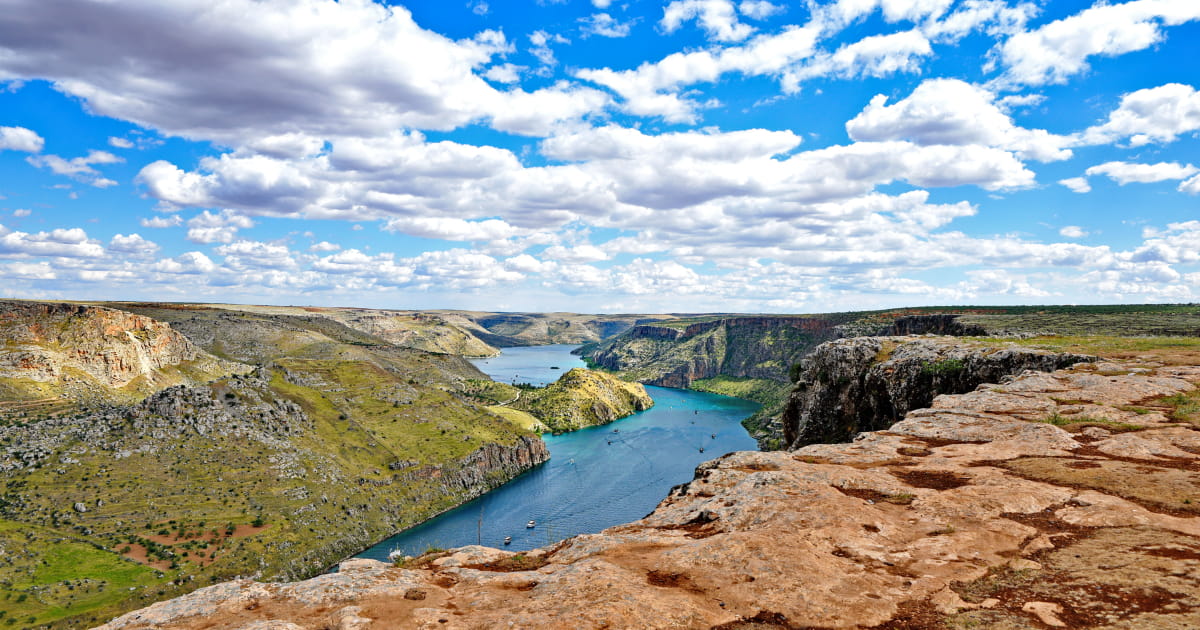
Halabiye and Zalabiye (هلابية و زلابية) The majestic twin fortresses stand as silent sentinels on opposing banks of the mighty Euphrates River in eastern Syria. Strategically positioned at a narrow gorge known as al-khanuqa (“the strangler”), these spectacular sites controlled a crucial ancient crossing point and guarded the frontier between powerful empires for centuries. While Halabiye is known by its classical name, Zenobia (linked to the legendary Palmyrene Queen), the shared history of Halabiye and Zalabiye documents the enduring geopolitical struggles that defined the Near East. The colossal walls and citadel of Halabiye and Zalabiye, later massively reconstructed by Emperor Justinian I, make them among the most impressive Roman and Byzantine frontier complexes (limes) preserved today.
Halabiye and Zalabiye | Quick Info.
| Feature | Halabiye (Zenobia) | Zalabiye |
| Location | Right (West) Bank of the Euphrates River | Left (East) Bank of the Euphrates River |
| Governorate | Deir ez-Zor, Syria | Deir ez-Zor, Syria |
| Ancient Name | Zenobia, Birtha, Halabit | Šalbatu (possible ancient name) |
| Key Historical Figure | Queen Zenobia of Palmyra, Emperor Justinian I | Queen Zenobia of Palmyra |
| Primary Architecture | Massive triangular walls, hilltop Citadel, two Basilicas, Praetorium, Cardo Maximus, Tower Tombs, Public Baths. | Rectangular plan, fortification walls, eight surviving towers, one gate. |
| Function | Trade center, Roman/Byzantine garrison, defensive fortress, frontier barrier (limes). | Complementary fortress, guard post. |
The Historical Tapestry: From Palmyrene Outpost to Byzantine Bulwark
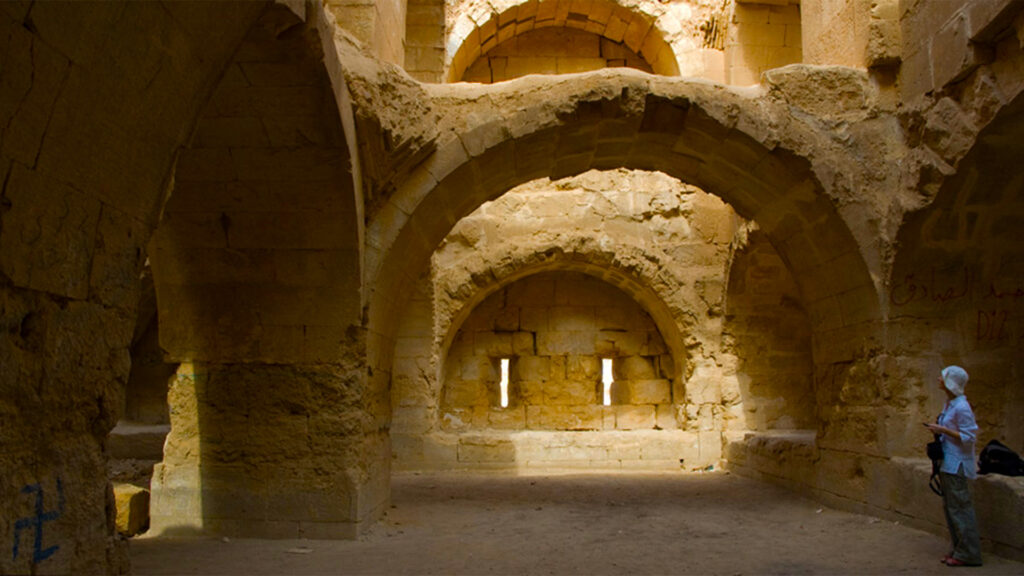
The history of Halabiye and Zalabiye is a microcosm of the endless geopolitical flux in the ancient Near East, a region constantly contested by the great powers of the Mediterranean and Persia.
Early Foundations and the Palmyrene Zenith
Evidence confirms Halabiye’s occupation since the 24th century BCE, though its massive fortifications date from the 3rd century CE. This crucial phase began around 266 CE when Queen Zenobia of the Palmyrene Empire seized the Roman garrison, Birtha. Recognizing the strategic choke point on the Euphrates, Zenobia heavily fortified and renamed the site Zenobia/Halabiye. Zalabiye was built concurrently as a watchtower. Following Zenobia’s defeat in 272 CE, the Romans reclaimed both fortresses, integrating them into the vital limes orientalis.
Justinian’s Masterpiece: The Byzantine Peak
The architectural zenith occurred in the 6th century CE under Emperor Justinian I (r. 527–565 CE). Obsessed with securing the Sassanian frontier, Justinian entirely reconstructed the city, as detailed by historian Procopius. He reinforced defenses against the Euphrates floods using a massive protective wall (probolos) and placed a formidable citadel on the high, dominating hill, making the city virtually impregnable.
Architectural Grandeur: A Study in Byzantine Fortification
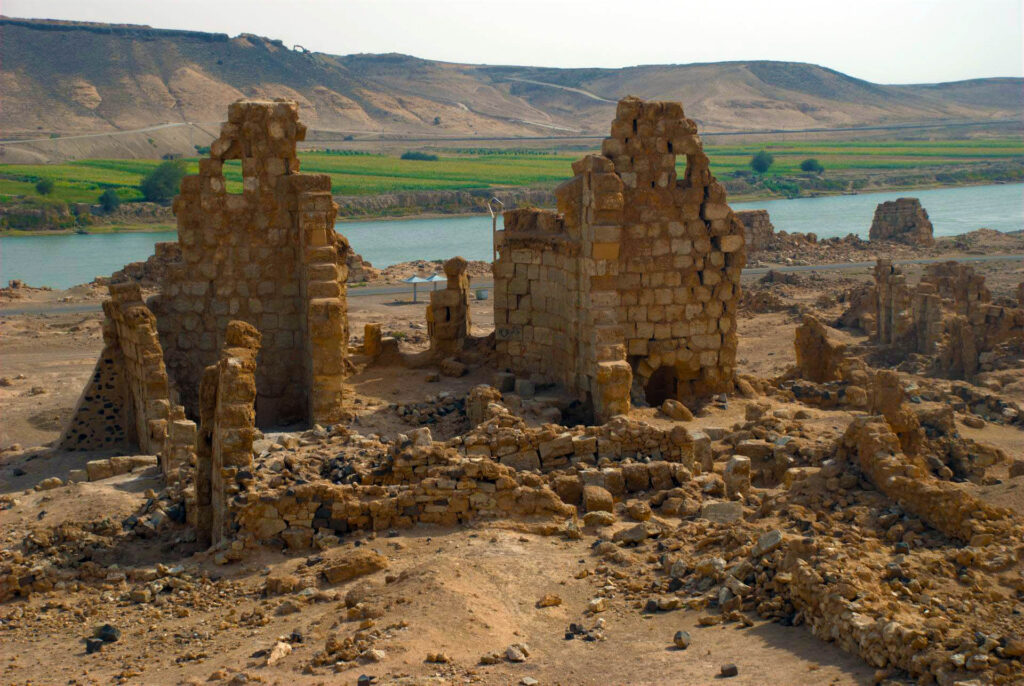
The ruins of Halabiye (Zenobia) offer a remarkably intact view of late Roman and Byzantine military architecture, specifically the adaptation of fortifications to challenging geography.
Halabiye’s Fortified Triangle
Halabiye’s city plan is distinctively triangular, determined by the natural boundaries of the Euphrates River on one side and two deep wadis (seasonal riverbeds) on the north and south. The apex of this triangle culminates in the Citadel, perched dramatically on a basalt outcrop high above the surrounding plain.
- The Walls and Towers: The most striking feature is its well-preserved circuit wall, which still stands to impressive heights. The walls are constructed from local basalt and limestone and are reinforced by numerous semi-circular and polygonal towers placed at short intervals. This dense arrangement provided overlapping fields of fire, a common late Roman defensive strategy.
- The Citadel and Urban Layout: The fortress on the hill summit is a multi-period structure, heavily rebuilt by the Byzantines. Its placement ensured that the inner garrison could hold out even if the lower city was breached. Within the defensive enclosure, the city was organized around a main thoroughfare, the Cardo Maximus, connecting the main gates. Excavations have revealed remains of a formal urban center, including a forum, public baths, and at least two notable Christian basilicas (the Northern and Southern Basilicas), which attest to the city’s importance as a Byzantine administrative and religious center.
Zalabiye: The Counterpart Fortress
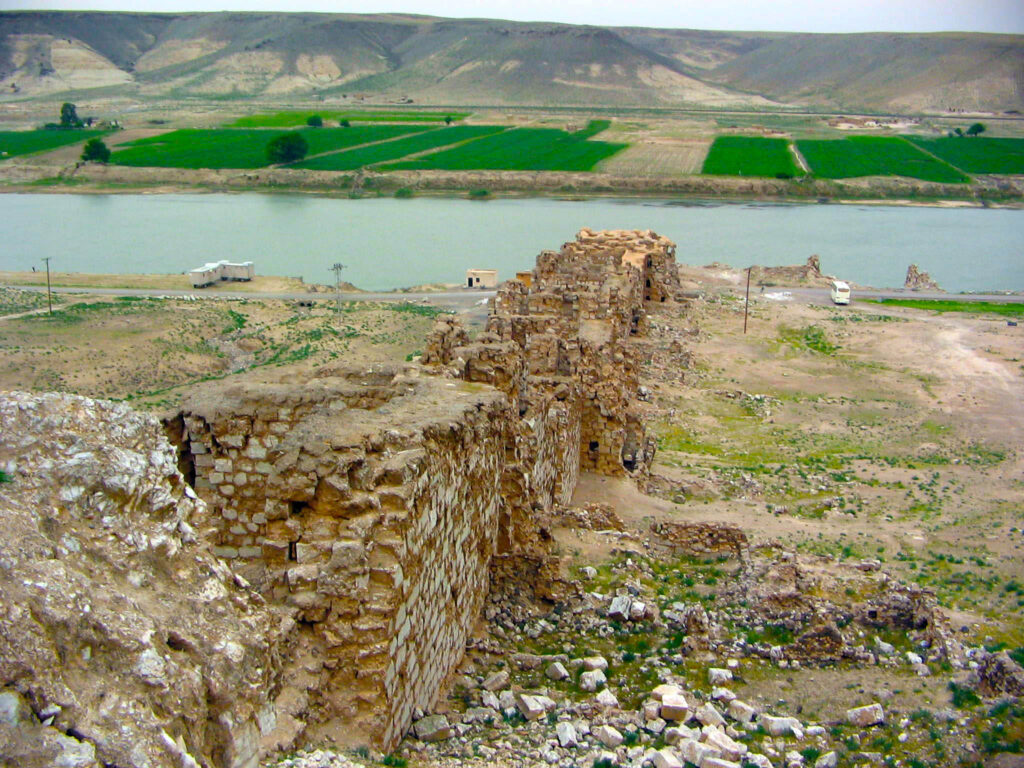
Located about 3 kilometers downstream on the opposite, less defensible, left bank, Zalabiye served as the twin complement to Halabiye and Zalabiye. It possessed a similar rectangular architectural plan with square towers, yet it is far less preserved than its counterpart. Due to erosion, earthquakes, and stone repurposing, only the eastern wall and a few towers remain. Nevertheless, its role as a crucial bridgehead fortification, safeguarding the eastern approach, was vital to the defensive strategy of Halabiye and Zalabiye, ensuring total imperial control over the narrow Euphrates passage.
See Also: Qalaat al-Rahba
Decline, Abandonment, and Modern Threats
The purpose of Halabiye and Zalabiye was inextricably linked to their position as the Byzantine-Persian frontier. Following the rapid expansion of the Arab Caliphates in the 630s CE, the strategic purpose of these twin fortresses vanished; the Euphrates was no longer an international boundary. Halabiye was briefly occupied and possibly altered by the early Arabs before being largely abandoned by the 8th century. Unlike many other Roman sites that were continuously inhabited, Halabiye and Zalabiye were left to molder, preserving their classical form beneath the desert sun.
In the modern era, these sites have faced renewed threats. The construction of dams on the Euphrates River upstream, particularly the Tabqa Dam forming Lake Assad, has altered the water flow, impacting the integrity of structures like Halabiye and Zalabiye near the riverbank. More critically, the Syrian Civil War has brought immense danger. Located in the eastern governorates, these sites have been subjected to damage from conflict, opportunistic looting by armed gangs, and neglect, compromising their historical record. While Halabiye’s monumental scale offers some protection, the remote nature of both Halabiye and Zalabiye makes them profoundly vulnerable.
Conclusion
Halabiye and Zalabiye, the fortresses of Queen Zenobia and Emperor Justinian, represent one of the most compelling surviving Roman and Byzantine frontier landscapes. Their architectural complexity, including the commanding citadel and unique twin-city configuration, speaks to the military engineering of late antiquity. These sites are essential witnesses to the turbulent history of the Euphrates Valley, documenting the final struggles between Rome and Persia.
If you have any questions, please contact us. To explore further, visit our website gallery for rare images and cultural highlights.
Sources & References:
UNESCO – World Heritage Centre: https://whc.unesco.org
Archnet – Architecture & Heritage Database: https://www.archnet.org
World History Encyclopedia: https://www.worldhistory.org
Syrian Heritage Archive Project: https://syrian-heritage.org
Global Encyclopedia: Wikipedia